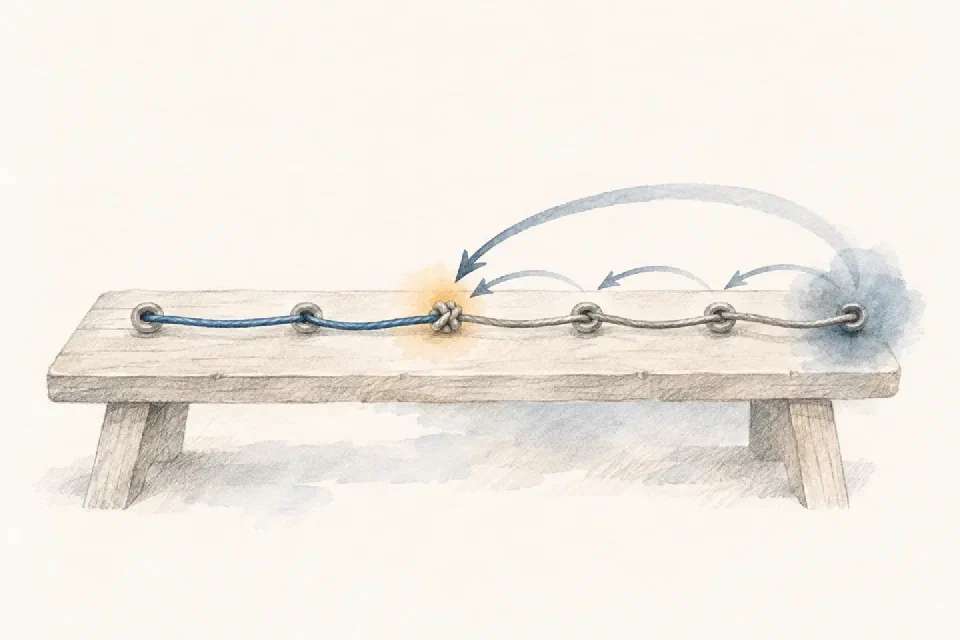
Why this exists
When the last step in a chain gives a bad answer, trace the output back one step at a time. Find where a fact went missing, changed, or first appeared before you edit a prompt.
How to use this protocol
- Save the original input, each step’s output, and the bad final result.
- Start with the final step and work back through the steps below.
- Check what each step got and what it sent on.
- Match the first break to one of the eight patterns.
- Use the table at the end to choose whether to fix that step or rebuild the chain.
The forensics workflow
Start by running the bad input three times. Save the model, settings, prompt version, tool results, and where it ran. Check where the runs first differ. Use what you find to pick the next test.
Save what each step got and what it sent on. Use fake data or a log with limited access. Leave out secrets and any personal details the check does not need.
Start at the final wrong output. Ask:
- Was the wrong content invented at this step, or passed through from the previous step?
- If passed through, the fault is upstream. Go back one step.
- If invented at this step, the fault is here. Stop and inspect.
Repeat until you find the step that introduced the error.
At the step where the error first appeared, inspect the input it received. The fault may be in the step itself (the prompt is wrong) or in the boundary (the previous step delivered something this step could not handle).
Use the catalog below. The named pattern tells you what to fix and what not to fix.
Step boundary inspection
At each handoff, check four things:
- Completeness. Did all expected fields make it across? Missing fields can encourage guessing unless the next step rejects incomplete input or preserves an explicit unknown.
- Fidelity. Was data reformatted in a way that lost information? "$1.2M revenue" compressed to “large company” loses the number.
- Provenance. Can you tell what came from the original input versus what was generated by an earlier step? If not, hallucinated facts will be indistinguishable from given facts.
- Confidence markers. Did hedging language survive? If step one said “Unverified: assumed Q3” and step two rephrased it as “Q3”, the hedge is gone and the chain has laundered uncertainty into a fact.
A handoff that passes all four checks is clean. A handoff that fails any one of them is suspect.
Eight chain-specific failure patterns
Pattern 1 - Compression loss
Pattern 2 - Hallucinated bridge
Pattern 3 - Format laundering
Pattern 4 - Confidence loss
Pattern 5 - Cascade contamination
Pattern 6 - Schema drift
Pattern 7 - Invisible truncation
Pattern 8 - Implicit ordering assumption
Rebuild versus patch matrix
After identifying the originating step, decide whether to patch the prompt at that step or restructure the chain.
| Diagnosis | Action |
|---|---|
| One pattern, one step | Patch the step’s prompt with the named fix. |
| One pattern, multiple steps | Add a single shared instruction (an instruction header included at every step) rather than editing each. |
| Two or more patterns at the same step | The step is doing too much. Split it into two steps with a clearer handoff. |
| Pattern recurs after patch | The fix is at the wrong step. Run forensics again starting one step earlier. |
| Pattern depends on input length | The chain has no compression strategy. Add a designed compression step rather than letting one happen accidentally. |
| Two steps disagree consistently | Either the steps have inconsistent role definitions, or the boundary format is ambiguous. Specify the boundary first; revisit the prompts second. |
Hand-off note
Pair this artifact with Three-Step Prompt Chain Map for chain design and Prompt Chain Validation Checklist for pre-launch verification. The map is the chain you build. The checklist is the chain you ship. The forensics protocol is what you reach for when the chain you shipped is producing wrong output and you need to find the cause before you change anything.
Fictional Example
In this made-up case, a follow-up email adds a rollout the client never named.
The visible failure. Step 3 produced: “As discussed, we will move ahead with a phased rollout starting in October.” Nothing like that appeared in the call.
Step 1 - Reproduce. Three runs against the saved transcript. The phrase appeared in two of three, worded differently each time. Recorded model, prompt versions, and the fact that retrieval is not part of this chain, so external state is ruled out early.
Step 2 - Capture intermediates. Step 1’s extraction and step 2’s selection were both logged. Without them this would have ended as “step 3 is hallucinating, tighten step 3” - which would have been wrong and would have held for about a week.
Step 3 - Walk backwards.
| Step | Contains “phased rollout”? | Verdict |
|---|---|---|
| 3 - generate | Yes, as prose | Passed through or invented? Check upstream |
| 2 - analyze | Yes, in include as item c3 | Passed through. Keep going |
| 1 - extract | Yes: {who: "client", what: "phased rollout", due: null, quote: "..."} | Invented here. Stop |
The originating step was 1, three steps away from where the problem was visible.
Step 4 - Inspect the boundary. The quote field read "…start small and see how it
goes before committing to everything." That is a real sentence from the transcript. The
quote-match validation passed, correctly. What failed was the mapping from that sentence to
the phrase “phased rollout” - the model had translated a hedge into a project-management term
and then attached an honest citation to it.
Step 5 - Match a pattern. Not compression loss; nothing was dropped. This is the inverse: confidence inflation at the boundary. Step 1’s job is to record what was said, and it recorded what was meant - using vocabulary the client never used. Downstream, “phased rollout” reads as a decided approach, because that is what it means to everyone who reads it.
Fix, at step 1 only. “Use the speaker’s own words in the what field. Do not translate a
description into a term of art. If the speaker did not name a thing, do not name it for
them.” Step 3, the visible offender, was not touched - it had correctly rendered the input
it was given.
Verification. The three saved runs now extract what: "start small before committing to everything", which step 3 renders as a sentence that sounds exactly as tentative as the
client did.
How to read this. The bad line showed up at step 3. Reading back through each saved step showed that step 1 turned a guess into a plan. Fix that step first. It kept the quote, but it lost the speaker’s doubt.
One limitation. This check needs what each step wrote. If you don’t have those records, set up logging and wait for the error to happen again. The last answer alone leaves you guessing where it started.